Questions about ways to improve your overall performance in Tetris and other miscellaneous matters.
Questions
Why should one stream Tetris to improve at it?
I learned to stream my gameplay on Twitch quite early in my Tetris journey.
The rationale, according to the founders of four.lol, a Tetris guide website, is that it helps to cultivate humility by having others judge you while you play.
When this happens, you are forced into improving to avoid the shame of being judged negatively if you flounder.
More importantly, streaming grants you several important tools:
- You can clip your gameplay and show it to Tetris coaches later to ask for improvements.
Here are my coaching comments to my student:
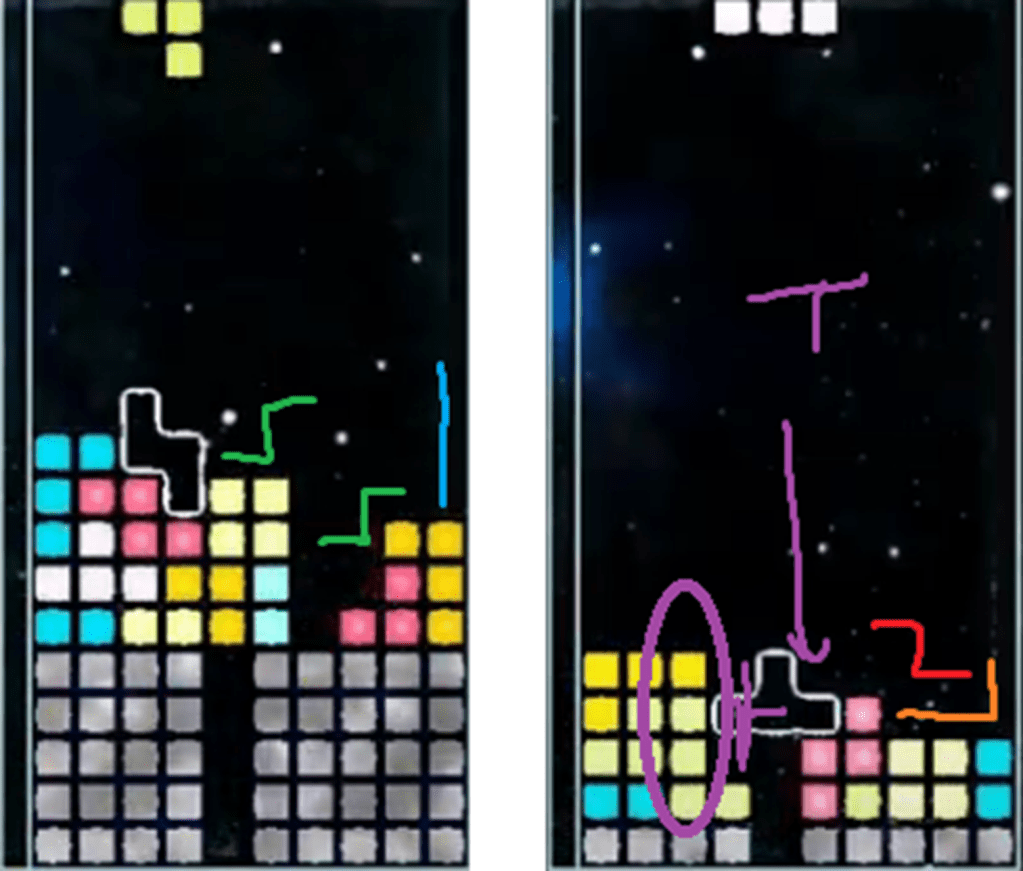
| The S, S, and I placements lead to a prophecy T-spin triple, the most optimal setup here. | The player can make a T-spin double donation using T, Z, and L. |
| C | D |
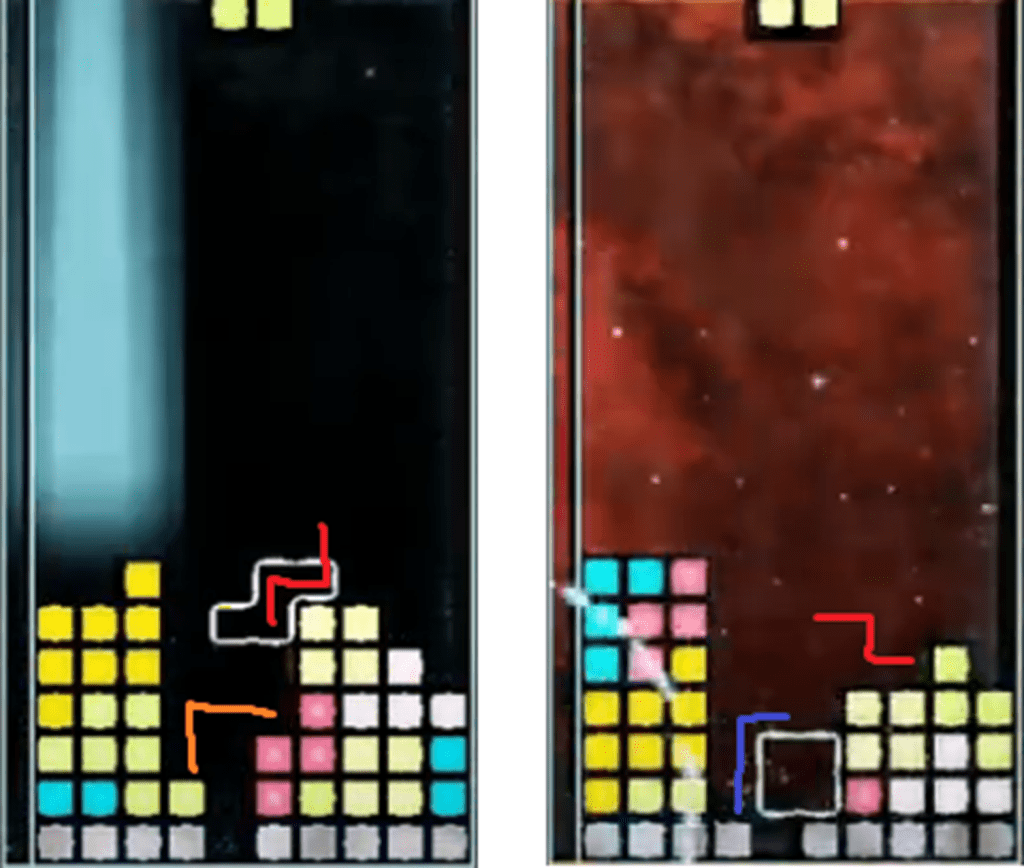
| The player can use Cremate, a prophecy T-spin double skim, to get a T-spin double. | A missed STSD. |
Here, one of my Tetris students sent me his gameplay, which I drew over in Paint to show where he could have improved.
ii. You can observe and study your own gameplay to see your weaknesses and strengths.
By replaying and rewatching your own Tetris footage, you can see where you are weak and how to optimize certain mid-game placements.
This directed learning is more effective than spreading your attention across many areas by merely “playing.”
Playing for long durations does not make one a Tetris master. In Tetris 99, many double-star level 99 players still do not have a fundamental grasp of parity management — a vital aspect of mid-game prowess.
iii. You can compile and upload your videos on YouTube or other media later.
When you have become extremely skilled in Tetris, you can upload your videos to demonstrate your skills to others.
This was what I did. After streaming for many years, I now have nearly 2,000 Twitch clips. Many of them have been compiled into my Tetris YouTube tutorial series online:
| Diagram Set 9-2 |
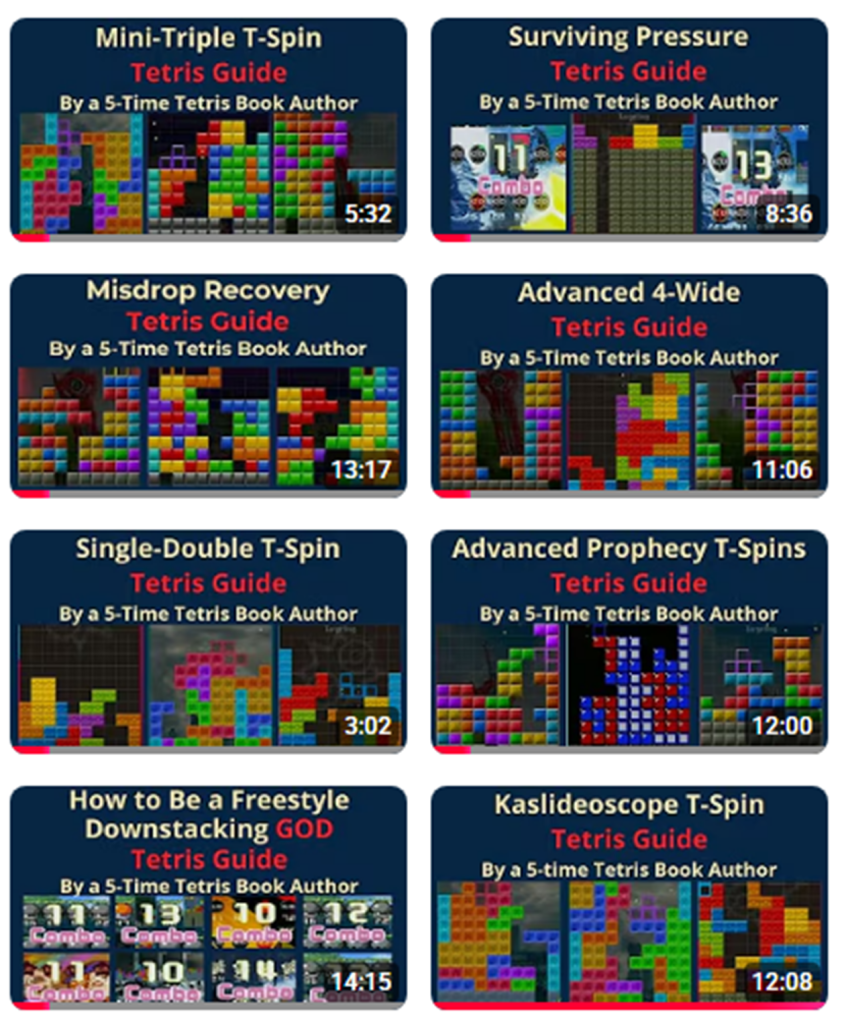
| Samples of my YouTube tutorial series. |
Hence, streaming Tetris confers many important benefits and shows that you are an enthusiastic Tetris student.
Why is teaching or coaching Tetris great for improving yourself?
Teaching or coaching Tetris forces you to cultivate meta-awareness or meta-cognition.
This means you understand why you choose certain setups and why you know it is so.
When you coach effectively, you are exposed to situations you may not have encountered consciously, which you can optimize.
By noticing them, you are forced to think through them deliberately, forging new neural connections that enlarge your overall span of Tetris methods.
The more you coach, the broader this range of awareness is, reaching domains such as downstacking, T-spins, skimming, stacking, and so forth.
I often review my coaching of other players by studying my students’ gameplay and my suggestions.
Over time, this boosted my understanding and knowledge.
Why does Tetris need further features to improve itself?
I am referring to official Tetris games, not unofficial ones like TETR.IO.
Currently, official Tetris games are rather balanced. It has a decent balance between T-spins, Tetrises, combos, downstacking, back-to-backs, and other features.
However, many unofficial Tetris games, such as TETR.IO, have implemented new features, including granting back-to-back bonuses on all spins, such as S or L spins. However, TETR.IO has gone too far with this, overcomplicating the game.
Adding new features can make Tetris more balanced. It can also raise the skill ceiling, retaining elite players for longer and attracting new cerebral players.
Here are features I recommend, and their rationale for being implemented:
- Let all-spins sustain back-to-back bonus.
This will instantly raise the skill ceiling by creating many more opportunities to make new all-spin setups, such as:
| Diagram Set 9-3 | |
| Mid-game Chance | |
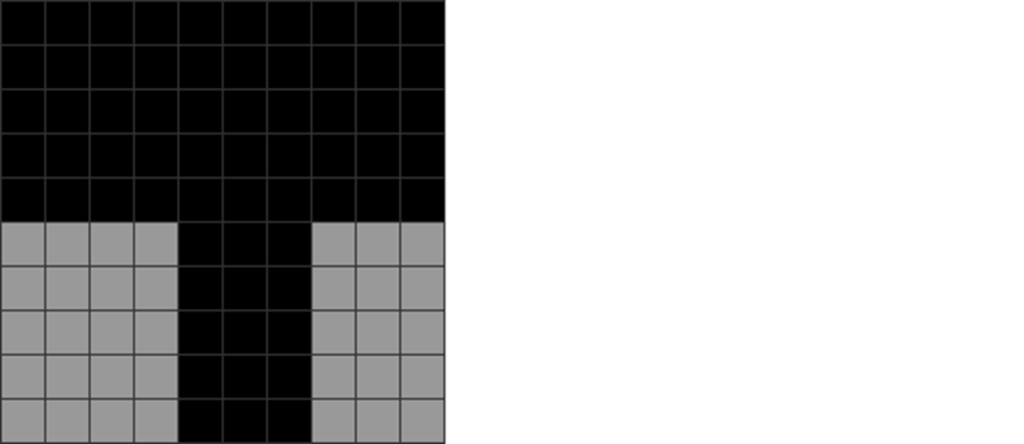
| This shares the same mid-game opportunity as an STSD. |
| A1 | A2 |
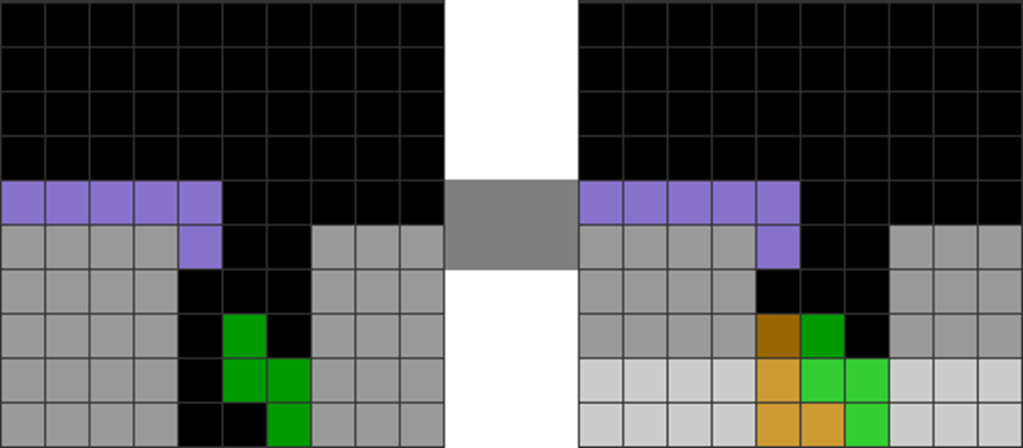
| This leads to an L-spin double. |
| B1 | B2 |
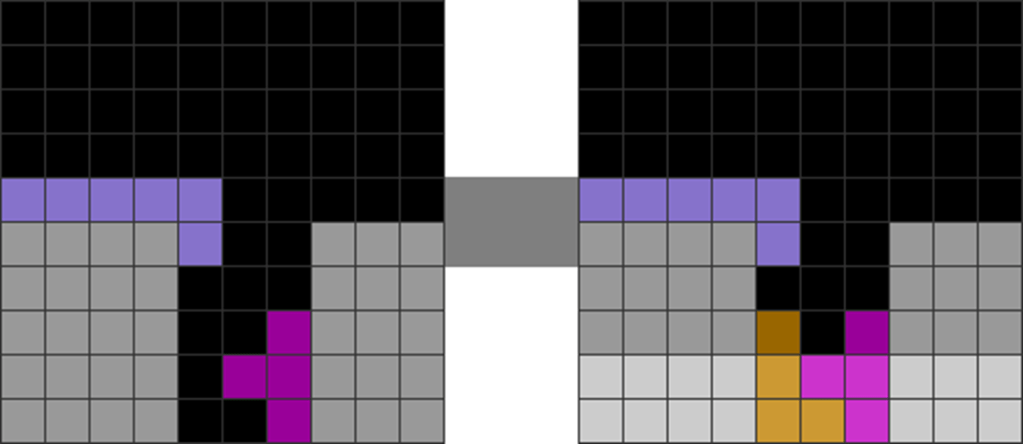
| This L-spin is also called One-piece Wonder. |
However, they should not be made as powerful as T-spins, nor should they add to a back-to-back surge counter like in TETR.IO.
How TETR.IO has implemented this encourages the terrible habits of overstacking and messing up the field just to sustain back-to-back bonuses and the surge counter:
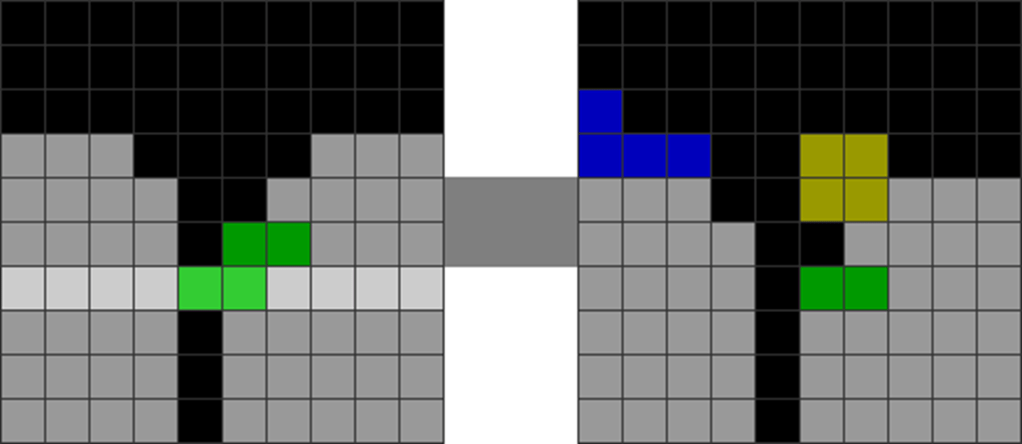
| An S-spin single concludes. | The player upstacks a bit with O and J. |
| 3 | 4 |
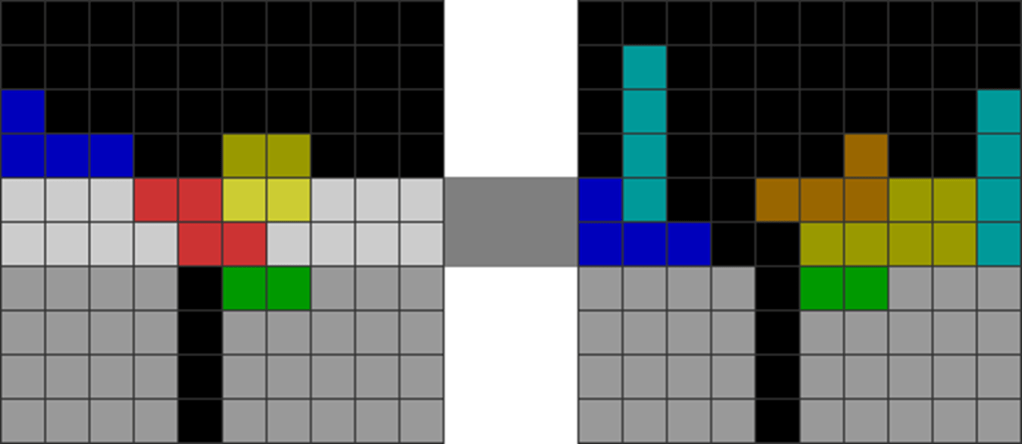
| He completes the Z-spin double. | He prepares another Z-spin double. |
This encourages poor gameplay and stacking options that are contrary to what a balanced Tetris game should be.
2. Implement all-color clears bonuses.
All-color clears occur when all upstacked colored blocks have been cleared:
| Diagram Set 9-5 | |
| 1 | 2 |
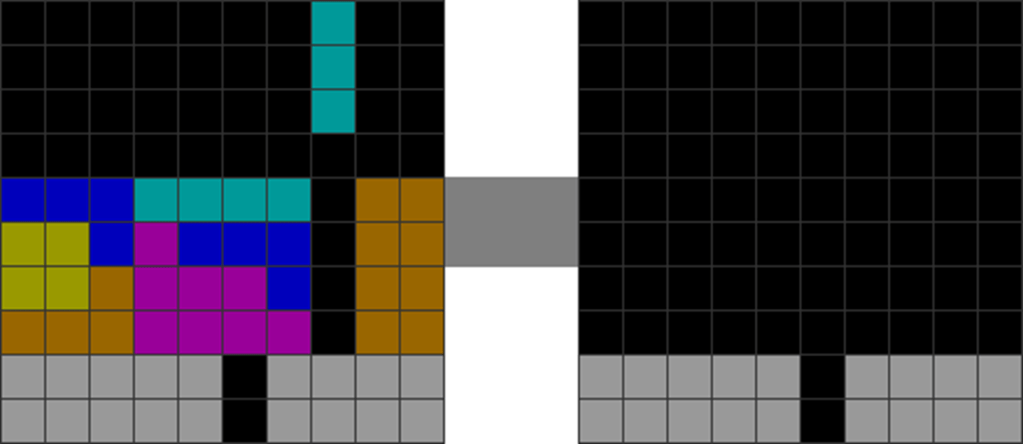
| A player prepares to Tetris line clear the colored blocks. | After the Tetris quad line clear, no colored blocks remain. Only garbage lines remain. |
They can be tweaked to offer a garbage bonus to increase the skill level of Tetris very slightly without introducing too many imbalances.
3. Implementing 180-degree rotations.
180-degree rotations increase the game’s skill cap significantly by letting you improve your stack or create new setups in novel ways, such as:
| Diagram Set 9-6 | |
| 1 | 2 |
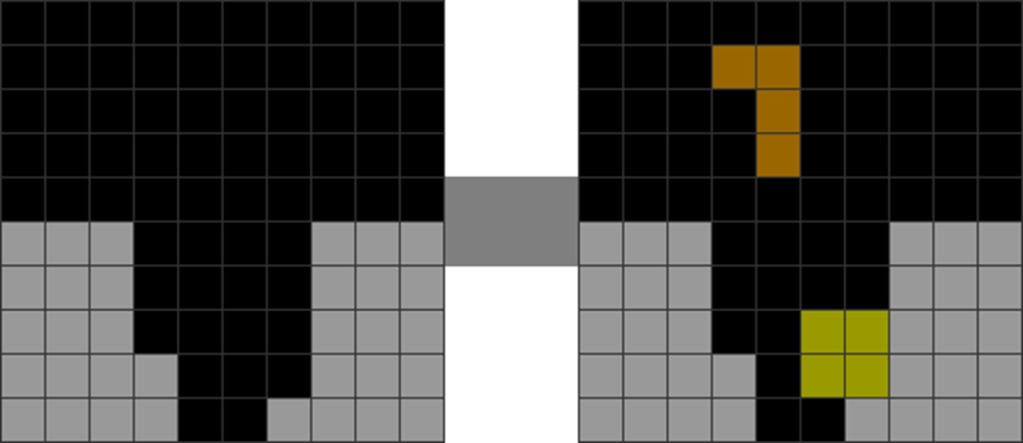
| 3 | 4 |
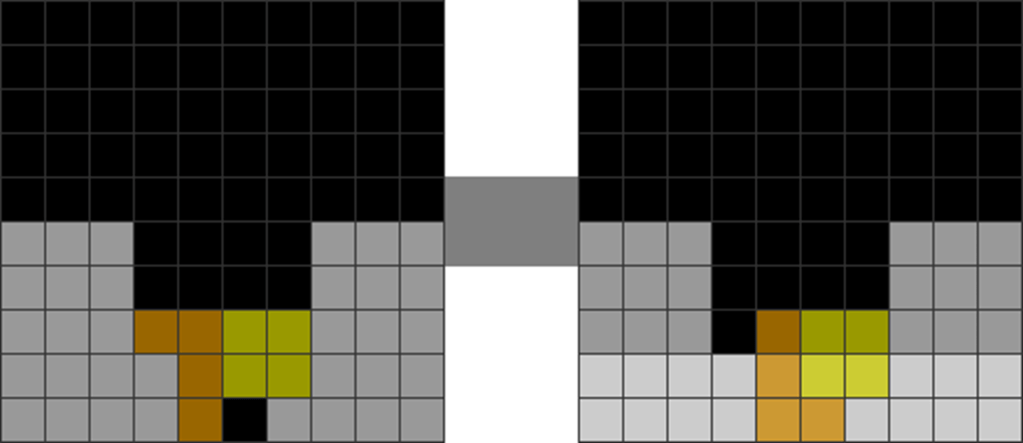
| A 180-degree L-spin double setup. |
These improve the suite of abilities a player also has to recover from misdrops.
4. Introduce a misdrop reversal function.
This can be a button that one can bind to revert the last misdropped or misplaced piece.
To prevent unnecessary stalling, it should include a cooldown.
Adding this increases the skill aspect of Tetris and reduces the RNG element, since games are won not by your opponent misdropping, but by you being better than the latter.
5. Reducing the spawn delay.
Most official Tetris games have a sizable spawn delay. This seems to have been reduced in Tetris Effect: Connected.
An innate spawn delay forces a player to slow down in between piece spawns, reducing their accuracy and speed.
Removing or reducing this allows the player to devote their valuable brainpower to more important matters rather than the aforesaid timing matters.
6. Introducing toggleable IRS and IHS.
First, here are the definitions for what IRS and IHS are:
IRS (Initial Rotation System): When enabled, IRS allows your rotate inputs to register before a piece spawns. This means the rotation is applied as soon as the piece appears, enabling faster and more accurate gameplay.
IHS (Initial Hold System): When enabled, IHS allows your hold inputs to register before a piece spawns. The hold action is processed as soon as the piece appears.
Introducing them lets one send inputs, such as rotate or hold, during the piece spawn delay.
This allows a player to be slightly faster and not over-worry too much about slowing down slightly to deal with the annoying piece spawn delay.
7. 4-wide balance.
4-wide methods, such as center 4-wides, have become extremely loathed meta-methods that require very little skill to create, yet have drastic outcomes.
Simply put, they are overpowered.
Tetris could introduce new means to nerf them by doing what Jstris did: by removing blocks above a certain row number (around 23 to 24) to prevent players from spamming center 4-wides just to win games. This overpowered meta-method effectively eliminates the need for the mid-game, which is where high-level Tetris counts.
8. Making some existing Tetris games more challenging.
The Tetris company and Nintendo have done a great job with Tetris 99, attracting many newcomers.
However, the game is currently too easy for expert players like me. The garbage is too clean, there is a 12-garbage limit, and long garbage reception intervals.
Perhaps it could implement a new mode that is similar to Invictus, but with the normal gravity of regular lobbies. However, its garbage reception time can be immediate, it can remove its 12-garbage limit, and the garbage cleanliness can be dirtier.
Doing so will create additional challenges in retaining Tetris experts.
 How to Tetris