“Tetris is not a puzzle to be studied, but a reality to experience. You must play and flow with it.”
—Galactoid
Just like Chess, Tetris has its rules and mechanisms. I will briefly introduce you to the game so you can understand this book.
How to Read My Tetris Diagrams
There are many ways to read this book’s diagrams. There are also many variations of how I present them:
Step Diagrams
Step diagrams are enumerated to show that there is a temporal sequence of a specific series of steps:
| Diagram Set 0-1 | |
| 1 | 2 |
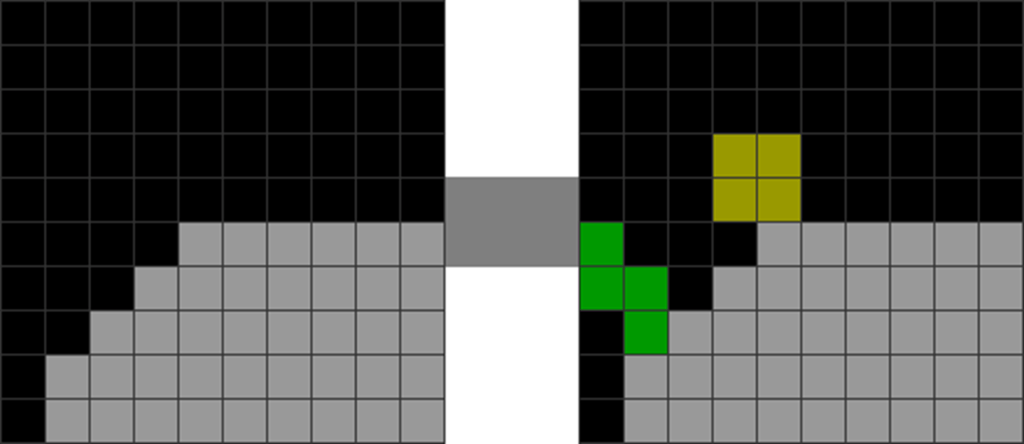
| Starting field. | One places S and O to make a T-spin. |
Here, “diagram Set 0-1” means it is the first labeled diagram set in chapter 0 (this introduction).
A gray bridge between the two steps connects them causally. Here, step 1 is the left diagram. After putting an S and O piece, it progresses to step 2 in the right diagram. The rest is self-explanatory. Gray blocks represent a generic shape. Yellows correspond to O pieces. Green corresponds to S pieces.
In this book’s terminology, I will sometimes refer to a specific block as being in column 2 and row 3. This means the block is in the second column from the left and the third row from the bottom.
Non-Step Diagrams
Non-step diagrams are non-causally linked diagrams, such as:
| Diagram Set 0-2 | |
| A | B |
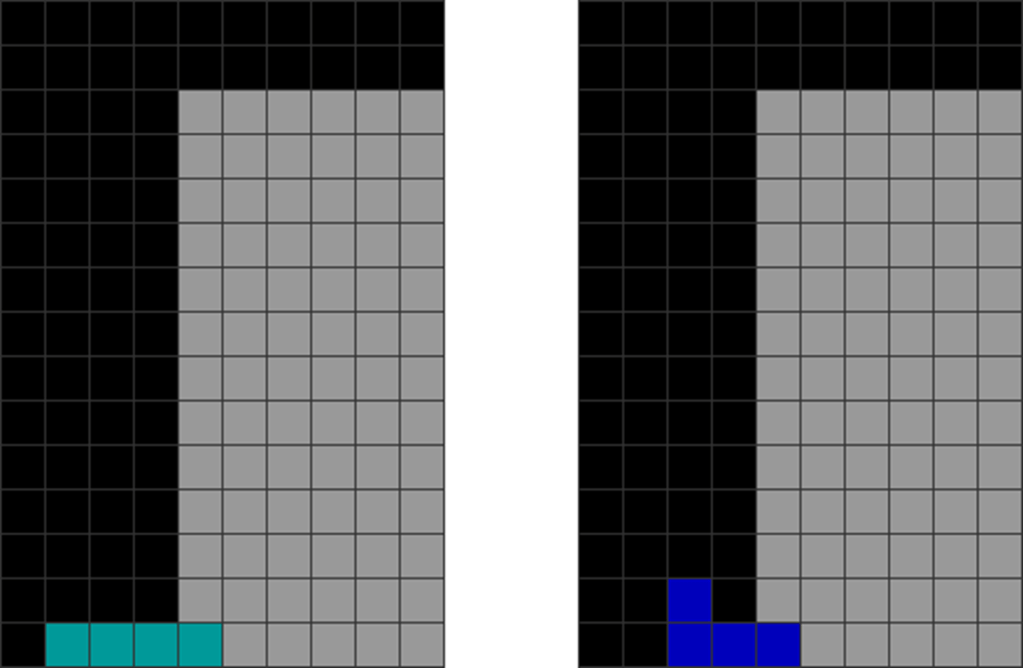
| These are two ways to make side 4-wide. |
The two examples above are not causally linked by a series of steps. They are independent of each other. The words in the gray box describe the diagram set.
Official Guideline Tetris Games
Guideline Tetris games are official Tetris games released by the Tetris company. Tetris is not just a solitary game. However, it has single-player modes like sprint, ultra, marathon, and others:
- 40-line sprint is a mode where one tries to clear 40 lines quickly.
- Ultra is a mode in which one tries to get the highest score by clearing lines in three minutes.
- Marathon is a mode where gravity starts slowly and speeds up later. The goal is to last as long as possible and score as high as possible.
- Versus modes involve a one vs one match, a free-for-all 4-player match in Puyo Puyo Tetris or Tetris Effect, or a battle royale in Tetris 99, a one vs 98 match. Players send garbage to each other’s fields to top out each other.
Tetris Mechanisms
Tetris has many mechanisms to note before playing.
1) The Tetrominoes
This game has seven basic Tetrominoes (Mino or Piece). Each tetromino is made of four blocks and has unique characteristics.
Everything in Tetris comprises these seven essential pieces.
| Diagram Set 0-3 |
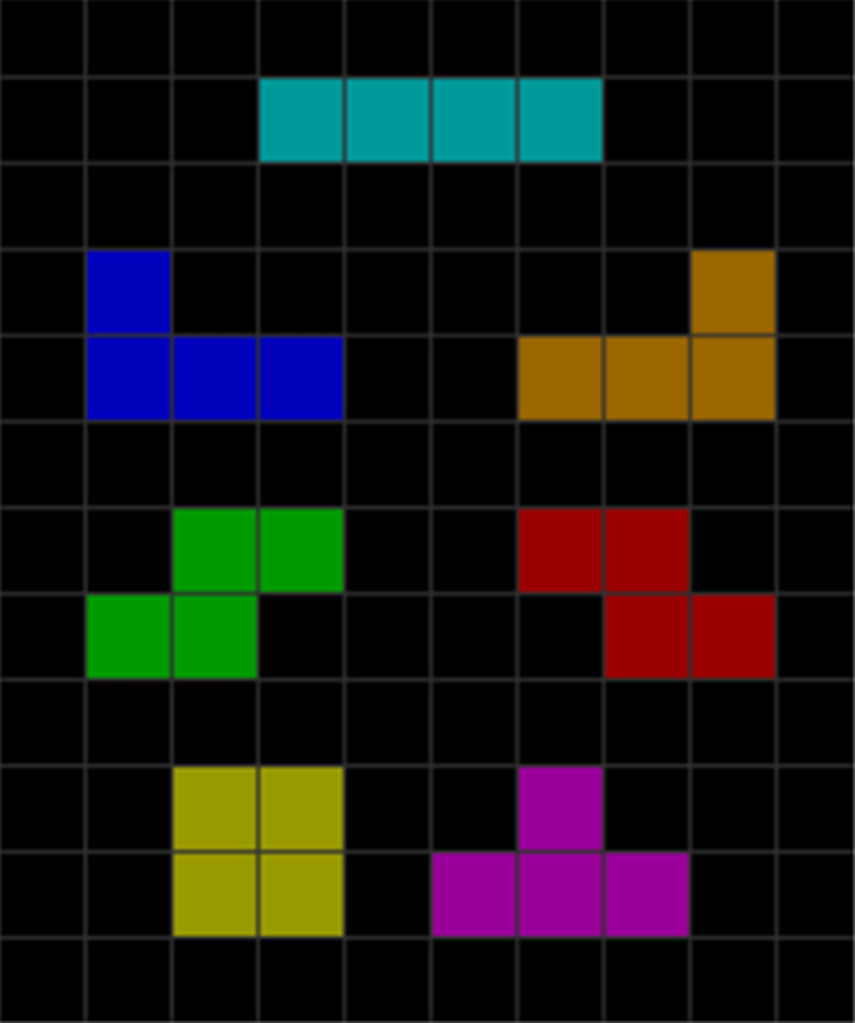
| The above shows the I (cyan piece), L (orange piece), J (blue piece), S (green piece), Z (red piece), O (yellow piece), and T (purple piece) pieces. |
2) The Basic Field
Tetris involves a 10×20 block field, 10 blocks wide and 20 blocks high:
| Diagram Set 0-4 |

| Each block in this 10×20 field can be empty or filled. Here, the black blocks typically mean they are empty. |
They can be filled with the seven minos: L, J, O, I, T, S, and Z.
Whenever an entire row (a horizontal line of 10 filled blocks) has been filled with blocks, it will vanish, and the stack on top will move down by one row. This disappearing mechanism is known as a line clear.
You top out and lose the game when a new piece tries to appear but cannot fully fit in the playfield because the spawn area is blocked:
| Diagram Set 0-5 | |
| A | |

| The red-circled area marks the spawn zone (around row 20). If it is blocked, the next piece cannot spawn, and you top out. |
3) Stacking and Jaggedness
Stacking is placing your pieces to construct many shapes in a Tetris field.
To properly stack your field, one vital concept is needed: parity.
Parity is loosely defined as the jaggedness of a field.
Here is an illustration of its importance:
| Diagram Set 0-6 | |
| 1 | 2 |
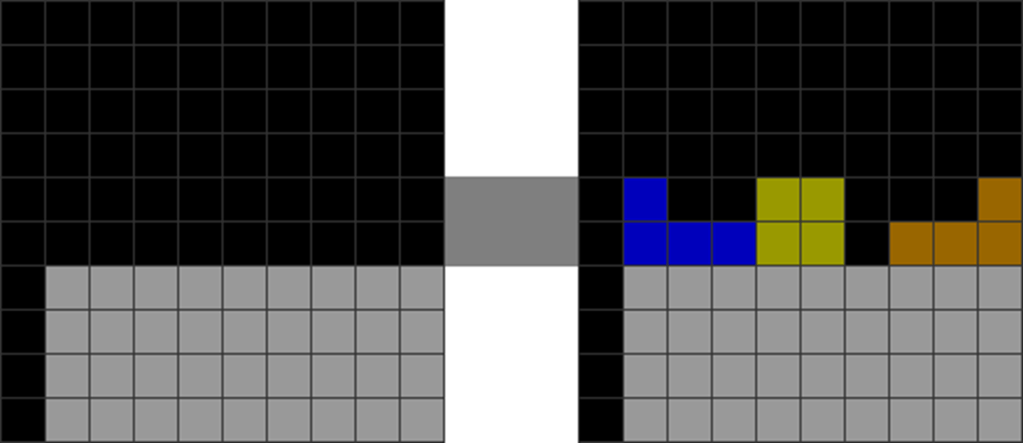
| The field is parity-balanced (flat). This lets you stack pieces easily. The horizontal L, J, and O pieces do not cover holes. |
| Diagram Set 0-7 | |
| 1 | 2 |
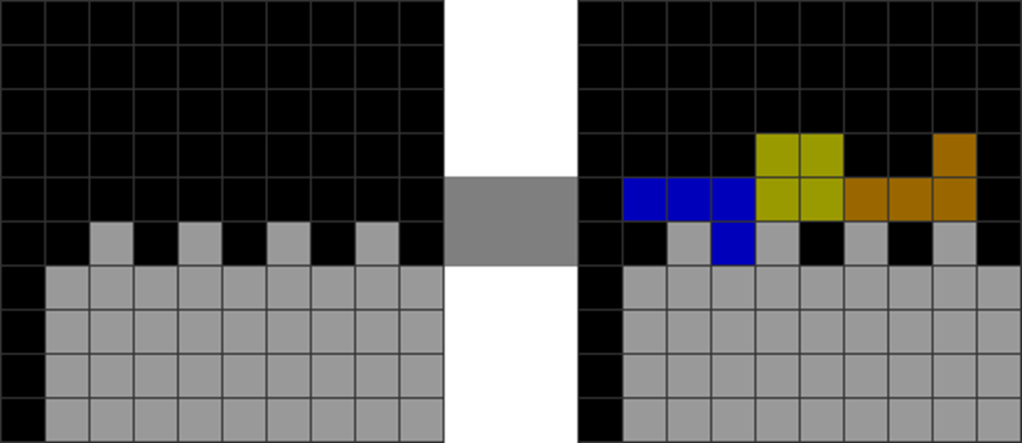
| The field is parity-imbalanced (jagged). This causes horizontal L, J, and O to have no places to be put cleanly. They cover holes. |
The more parity-imbalanced (jagged) the field is, the more challenging it is to stack properly and cleanly.
Some pieces alter parity, such as the T piece, which can be a bane or a boon. Overall, good stacking requires the proper management of T pieces and parity.
4) Previews
The following shows a standard Tetris field with the hold and preview columns beside it.
In Modern Tetris, you have a preview in the upper right corner of the 10×20 field (in the red circle here):
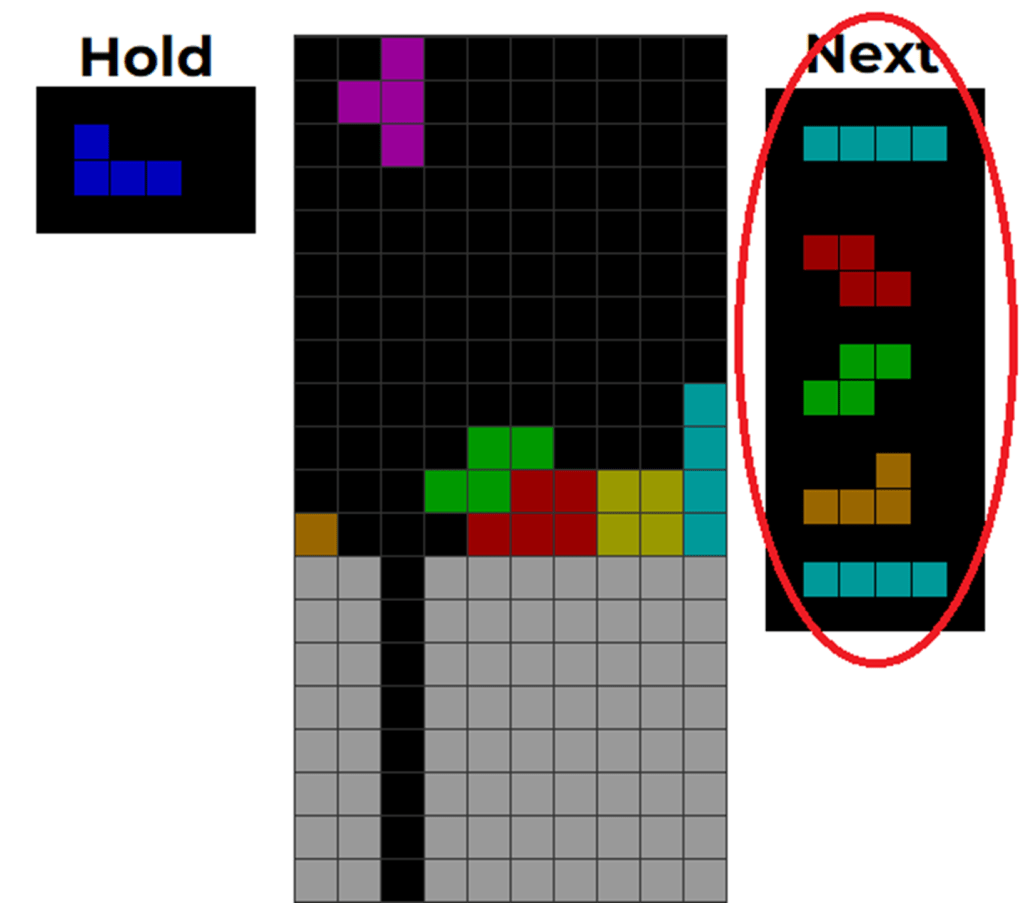
In some games, this preview may be at the top. This preview shows the incoming pieces in chronological order: I, Z, S, L, and I. The number of previews ranges from one to six.
5) Line Clear Types and T-Spins
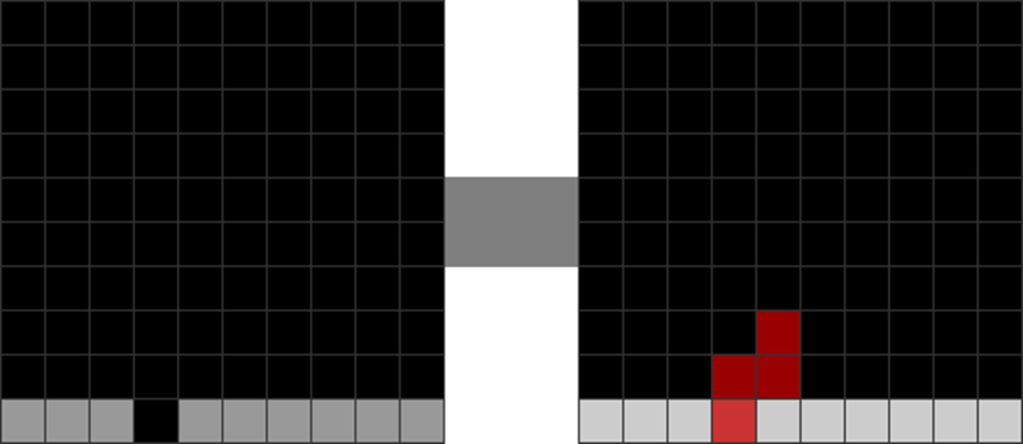
A line clear occurs when an entire row is filled with blocks, thus making it disappear:
Singles:
| Diagram Set 0-8 | |
| 1 | 2 |
| 3 |

| A Z piece clears a single line in step 2, leaving only red blocks. A single line clear is called a single. |
Doubles and Triples:
Doubles and triples can be generalized from single line clears. They clear two and three lines respectively.
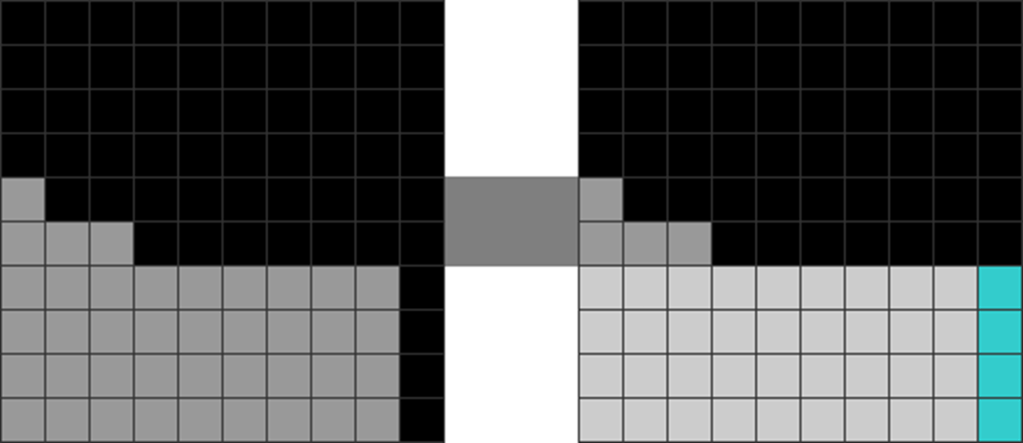
Quads/Tetrises:
| Diagram Set 0-9 | |
| 1 | 2 |
| 3 |
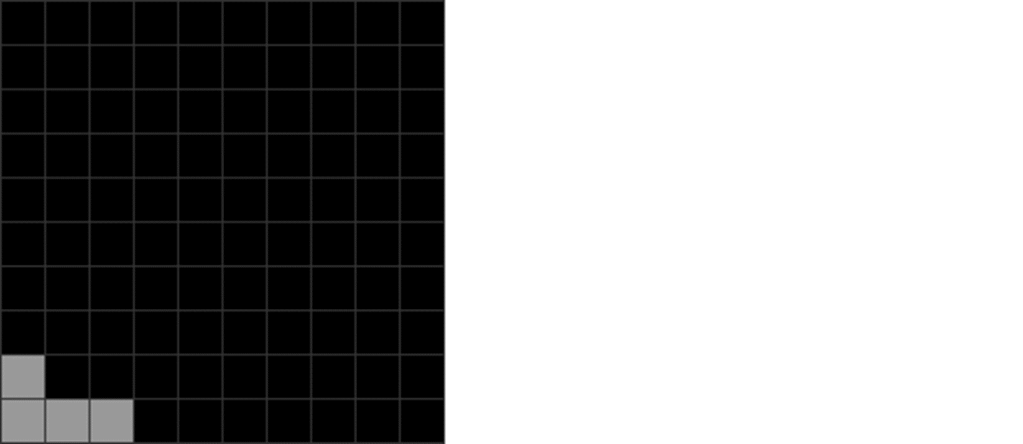
| Whenever four lines disappear at once, especially with an I piece in step 2, this is called a Tetris or quad. |
T-Spins:
Whenever one, two, or three lines disappear because of a rotated T piece line clear, it is called a T-spin line clear:
| Diagram Set 0-10 | |
| 1 | 2 |

| This T-shaped cavity is a T-spin setup. | The player inserts a T piece inside the cavity, clearing two lines. |
| 3 |

| You are left with this field. |
Because the above T-spin clears two lines, it is called a T-spin double. T-spin minis, singles, and triples exist, clearing one, one, and three lines respectively.
T-spins are vital because they are powerful offensive techniques that send significant garbage lines to your opponent.
In official guideline Tetris games, line clears incur a significant line clear delay. This is the time it takes for a line to vanish upon a line clear.
6) Garbage and Downstacking
Garbage is an element added to modern Tetris games. It often appears in one-versus-one or other multiplayer modes. It is marked by gray-colored blocks rising from the bottom (red circle):
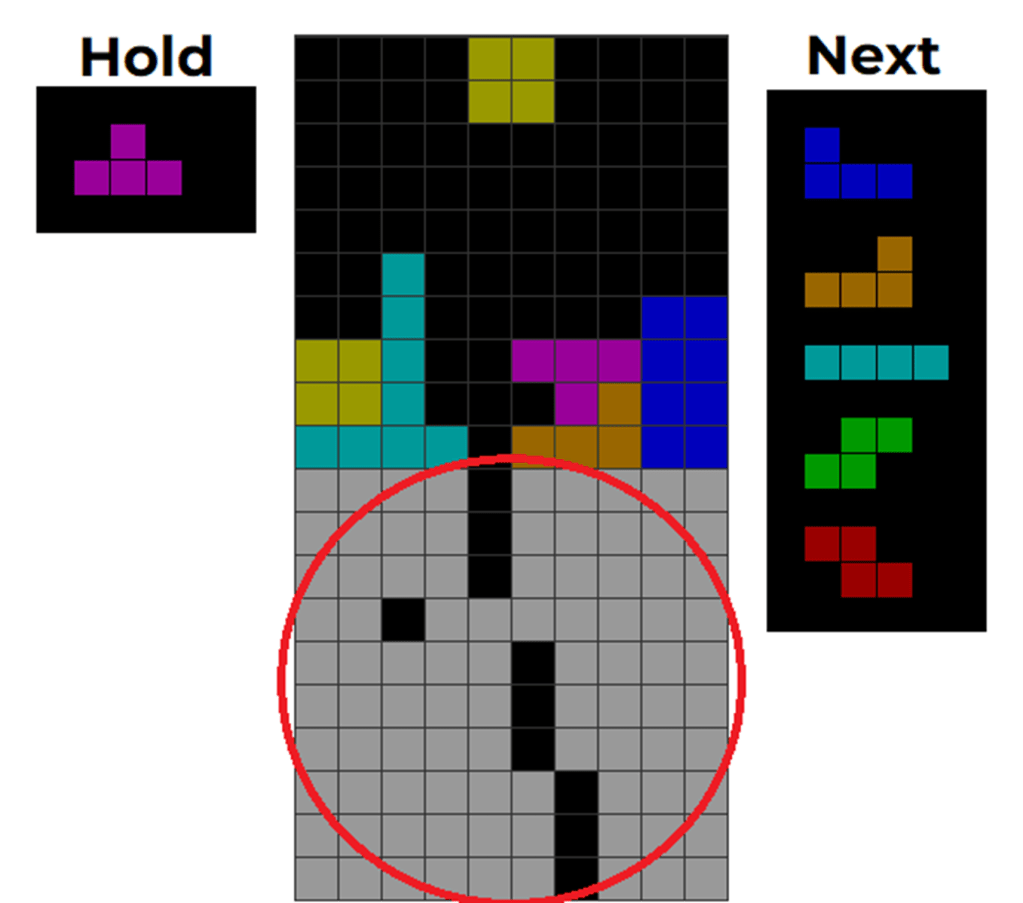
You can send garbage to the opponent whenever you do a double, triple, quad (Tetris), T-spin line clear, or combo.
Whenever you consecutively line clear, you may send extra damage, called combos, to the opponent. This means the line clears are joined and connected one line clear after another without breaking.
However, if you do more than one consecutive T-spin or Tetris, you incur a back-to-back bonus (BtB or B2B). This adds an extra line of garbage to the next T-spin or Tetris until the streak is broken by a non-T-spin or non-Tetris line clear.
Downstacking is the ability of a player to dig down through colored or garbage lines to the bottom as far as possible:
| Diagram Set 0-11 | |
| 1 | 2 |

| This shows a starting field with a J-like cavity in the middle. | The player inserts a J piece into the cavity, triggering a triple line clear. |
| 3 | 4 |
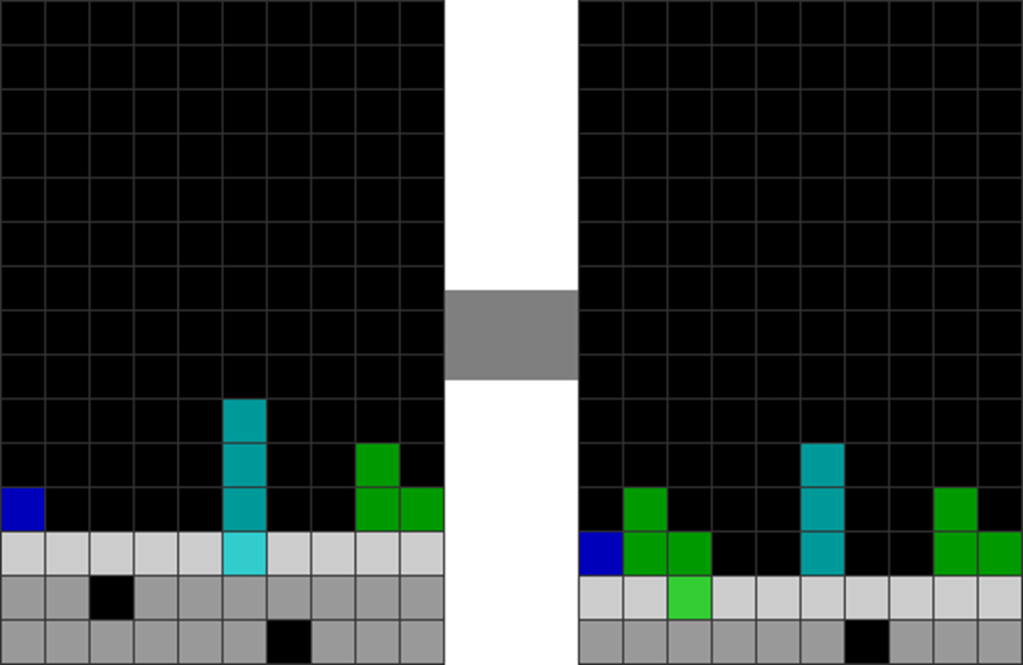
| The player continues the downstack sequence with an I piece to create a single line clear. | He inserts an S into the next garbage hole to create a single line clear. This exposes the hole in column seven. |
This is a vital multiplayer skill, as getting down is a defensive approach that negates an opponent’s garbage.
 How to Tetris