“Tetris is not a puzzle to be studied, but a reality to experience. You must play and flow with it.”
— Galactoid
Don’t Play Tetris? Don’t Worry!
This book uses Tetris as a metaphor to teach spirituality.
You do not need to be a Tetris player or expert to benefit from this book.
I have kept the Tetris examples as simple as possible for readers who have never played the game.
If a Tetris diagram confuses you, skip it — the text will carry the spiritual and philosophical lesson. Both spiritual and Tetris terms are defined in the glossary at the back.
Tetris: The Universal Language That Shapes Thought
Have you ever read The Story of Your Life by Ted Chiang? Or, more popularly, its movie adaptation: The Arrival.
The main theme is that the protagonist learns an alien language that rewires her brain. This causes her to conceptualize alien concepts in ways ordinary human language could not.
With this new tongue, she gains the ability to see the past and the future.
As a novelist myself, I use this as one of the core mechanisms in my The Eternal Reflection series.
My main protagonist and her supporting cast learn the ancient language of Ei’lara (meaning “threads of oneness”).
This four-dimensional spatial language shapes their minds, helping them understand profound spiritual concepts grounded in Eastern philosophy with ease.
In linguistics, this is called the Sapir-Whorf hypothesis, which states that language alters the way we think.
The Pirahã people of the Amazon lacked specific words for exact numbers, so they struggled to count large flocks.
And the Guugu Yimithirr people of Australia use absolute cardinal directions (North, South) rather than left or right, resulting in superior spatial directionality.
In real life, the circumstances could not be any more uncanny, since such a mythical language really exists!
It is a spatial language you learn by playing the most popular video game ever.
It is called Tetris.
And it is the secret cosmic language that, once learned, allows you to gain spiritual and philosophical insights that can broaden your perspective and change your life.
I am not exaggerating — I derived thirty spiritual laws from Tetris, which form the entire basis of this book.
Your mileage might vary if you play the game, depending on how far you relate Tetris to spirituality.
My Tetris Experience
As of this book’s writing, I have been playing Tetris for nearly seven years.
I still remember my very first serious Tetris game: Puyo Puyo Tetris.
My first opponent was PokeDialga, a famous Taiwanese Tetris player. It was a disaster. I saw him spamming a jagged pattern and inserting T pieces into it.
My field rose and rose and rose. I did not know how to play and kept dropping my pieces at random. Then, it ended. In less than half a minute.
Fast forward seven years, and I have published eight Tetris guidebooks (the How-to-Tetris series) and created two reputable Tetris guide websites.
In the process, I have gained more than I asked for. I have amassed an unholy trove of Tetris techniques that I have interwoven into my mid-game with utmost surgical and strategic proficiency.
However, I could not have known there was more: that, by playing Tetris and meditating on its many themes, the game had sculpted my brain into something unprecedented.
It made me realize the vast associations between spirituality and Tetris. Tetris is a metaphor and a form of spatial language that teaches many, many important philosophical lessons.
Think about it: regardless of your profession, you have probably philosophized a lot about your area of expertise.
In Japanese martial traditions, students were often asked to practice a single fundamental movement repeatedly for years before advancing.
Many eventually developed entire philosophies relating life to the sword and the act of cutting.
Regardless of your major, you might notice something peculiar: the highest degree is known as a Ph.D., or a philosopher’s degree.
Likewise, if you trace each Wikipedia article long enough, they all return to their shared origin: the page on philosophy.
Hence, all roads lead to philosophy.
And Tetris, be it a guiding light that teaches us the law of oneness or love, was the language that led me to write this book, glorifying its philosophy in all its splendors.
Like Chess, Tetris has its own rules and mechanics. I will briefly introduce you to the game so you can understand this book.
Where to Play Tetris
To play Tetris, simply go to the official Tetris website at Tetris.com and click on the “Play” button:
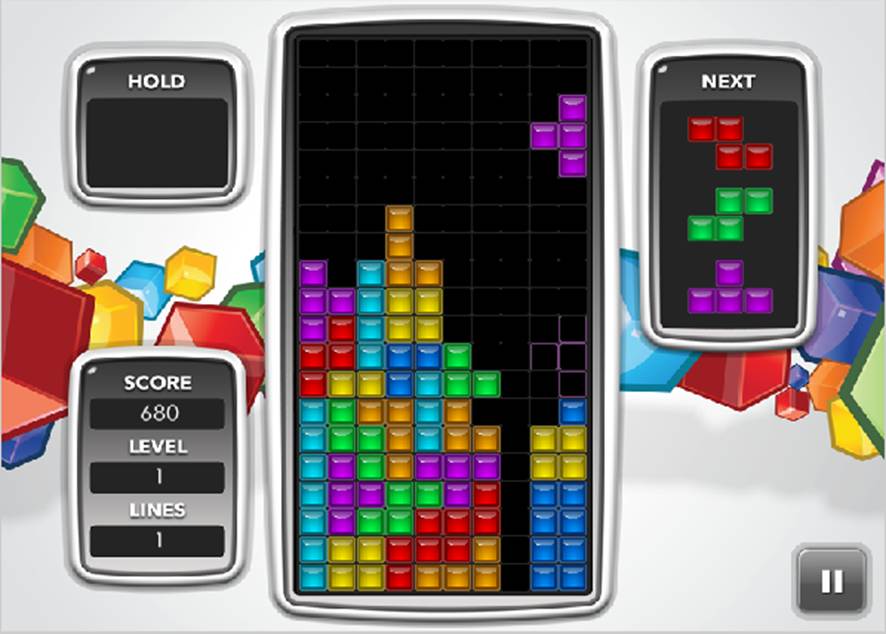
Bind your keys and begin a match!
If you like higher-quality Tetris games, you can try the following official Tetris games:
- Tetris 99: Available on the Nintendo Switch.
- Puyo Puyo Tetris 1, 2, & 2S: Available on many platforms.
- Tetris Effect: Connected: Available on many platforms.
- Tetris: The Grand Master (TGM) Series: Available on many platforms.
Unofficial Tetris-style games also exist online for free. I will not name them here, as I prefer to support the official Tetris ecosystem.
What a Tetris Match Is Like
Because many readers may be unfamiliar with Tetris, readers only need to know four main Tetris concepts.
The book repeats these four concepts, but it also covers others, which I will explain simply and clearly when I use them.
I will explain these technical terms in more depth in the How to Read My Tetris Diagrams chapter after this one.
I illustrate these four concepts with a hypothetical one-versus-one Tetris match below.
The Setting
In versus matches, you will typically see your field (left side) and your opponent’s field (right side), like this:
| Diagram Set 1 |
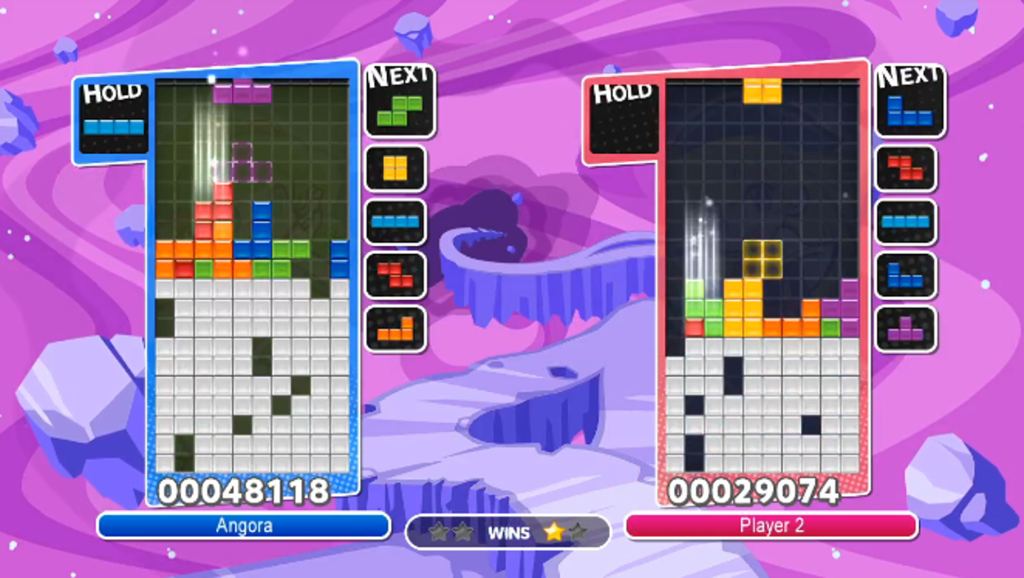
| A typical match in the game Puyo Puyo Tetris. |
Your goal is to defeat your opponent.
In this book, however, we focus not on winning but on what the game teaches us about life.
The following diagram sets show an eleven-step continuous sequence.
Stacking
When the match first begins, your field is empty.
Hence, you typically must stack it up with tetrominoes (pieces) like this:
| Diagram Set 2 | |
| 1 | 2 |
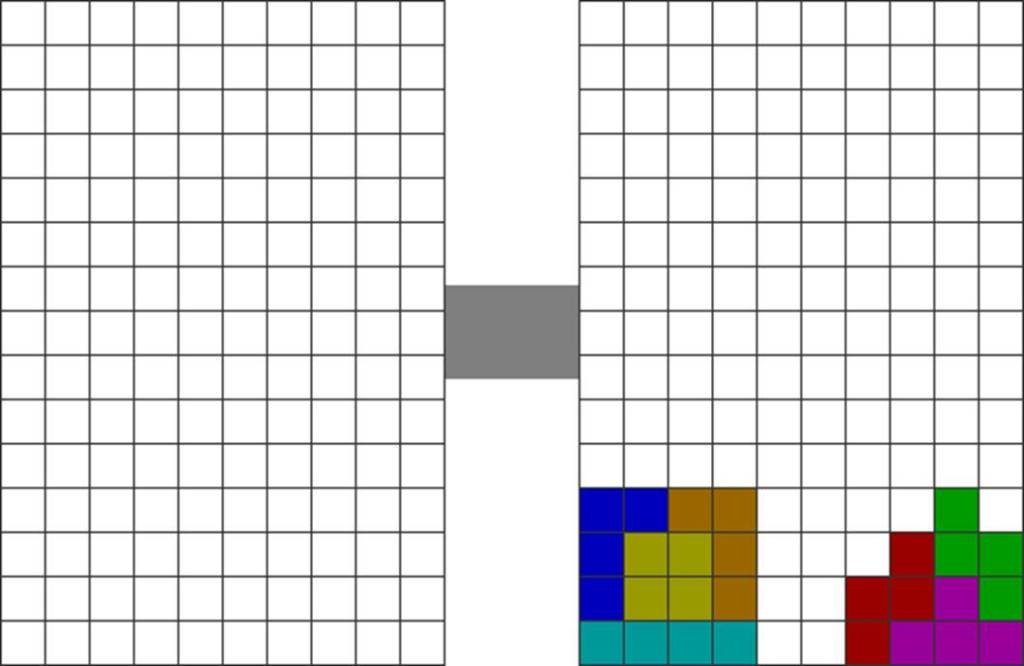
| An empty field. | You stack the tetrominoes (pieces) this way. |
The Tetris
The most popular attack is the Tetris, which clears four lines simultaneously.
The above diagram set’s step 2 then continues into the following diagram set’s step 3:
| Diagram Set 3 | |
| 3 | 4 |
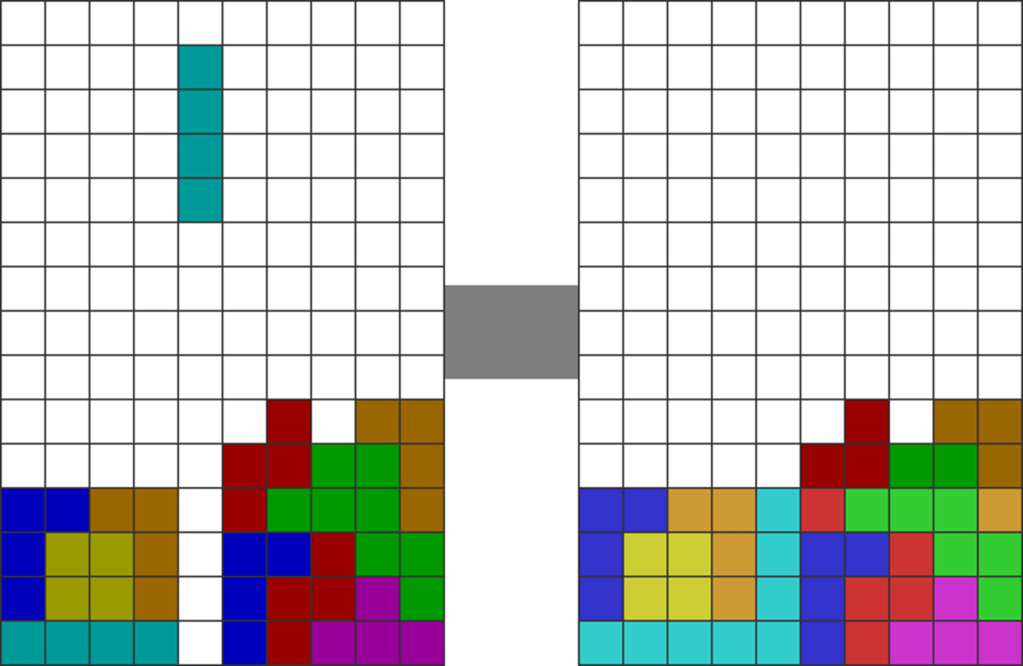
| You continue stacking the field. An I piece is ready to be inserted into the central hole. | You insert the I piece into the central hole. This causes a short animation where 4 lines begin vanishing. |
| 5 |
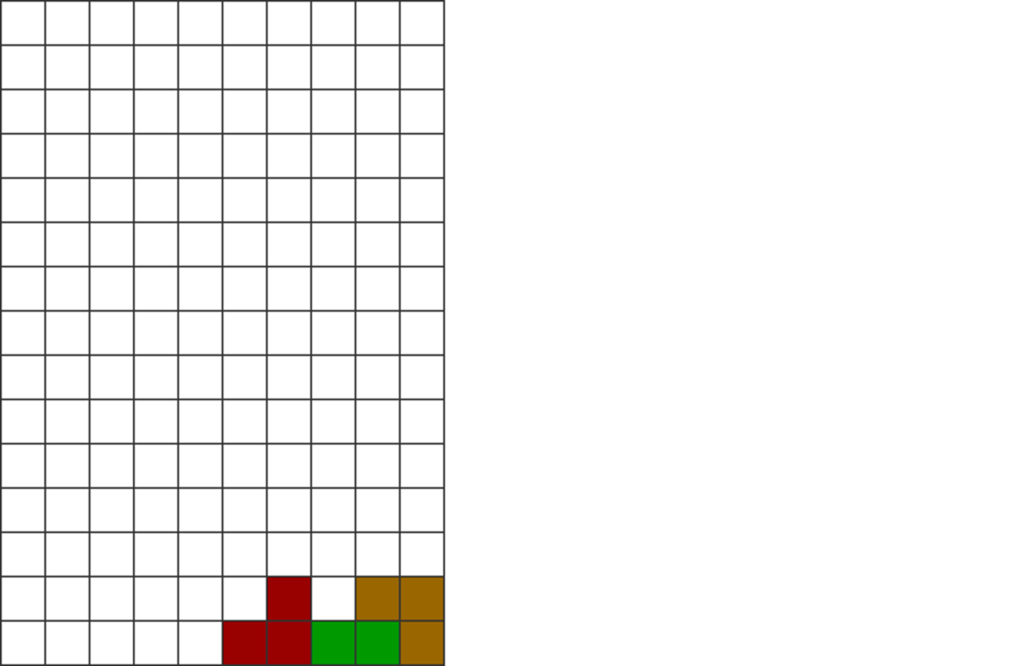
| The 4 lines completely vanish. The blocks above the original 4 lines cascade down. You are left with this field. |
This then attacks your opponent’s field.
The T-Spin
Another popular and major attack is called the T-spin, which I will explain in greater depth later.
It involves inserting a T piece into a T-shaped cavity like this (continuing into step 6 from the last diagram set’s step 5):
| Diagram Set 4 | |
| 6 | 7 |
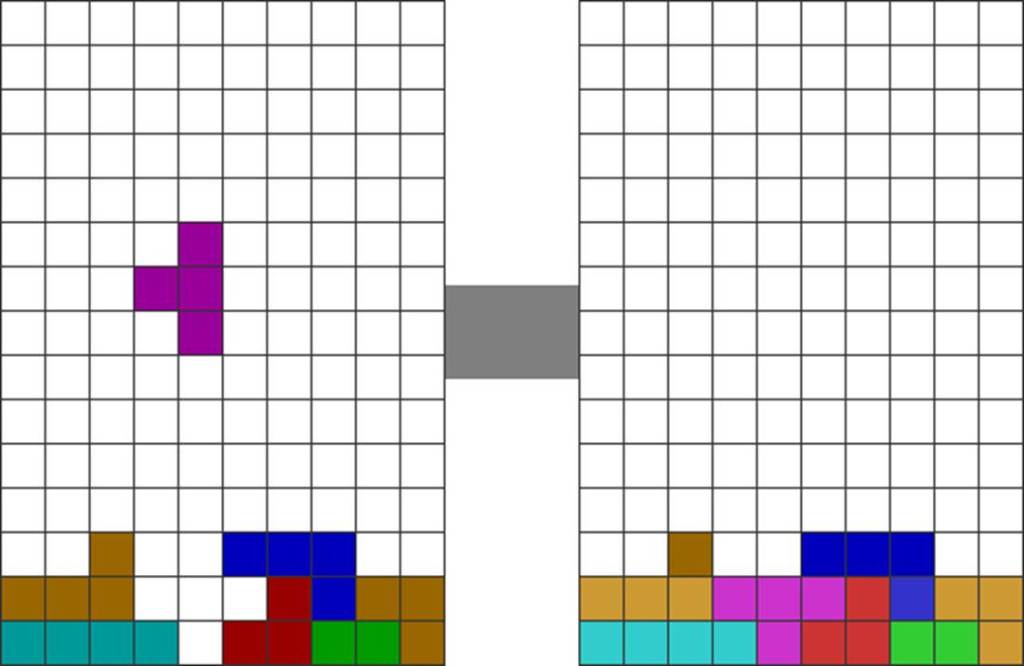
| You build up to this T-shaped cavity. You slowly lower a T piece into it. | You insert the T piece, causing an animation delay. 2 lines begin vanishing. |
| 8 |
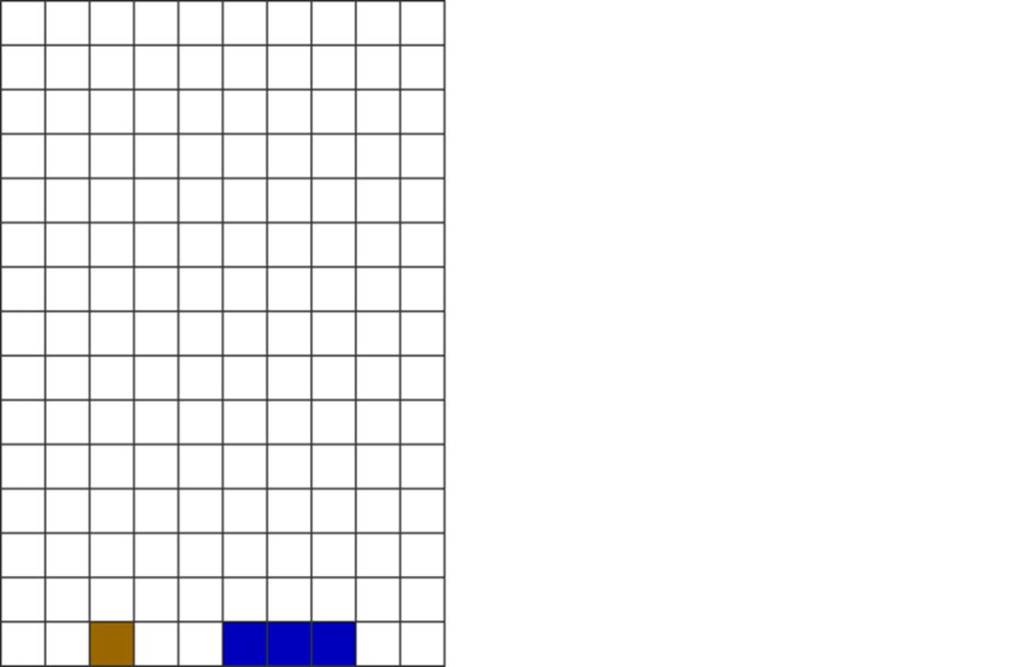
| The 2 lines vanish. The blocks above them cascade down. You get this resultant field. |
This then sends a respectable burst of attacks to your opponent’s field.
Digging Down
Digging down, also known as downstacking, lowers your field’s height. This is a form of defense.
Here, in the diagram below, your opponent sends you a burst of attacks. Your field rises with new gray blocks (garbage lines).
To defend, you must lower your stack, like this (continuing into step 9):
| Diagram Set 5 | |
| 9 | 10 |
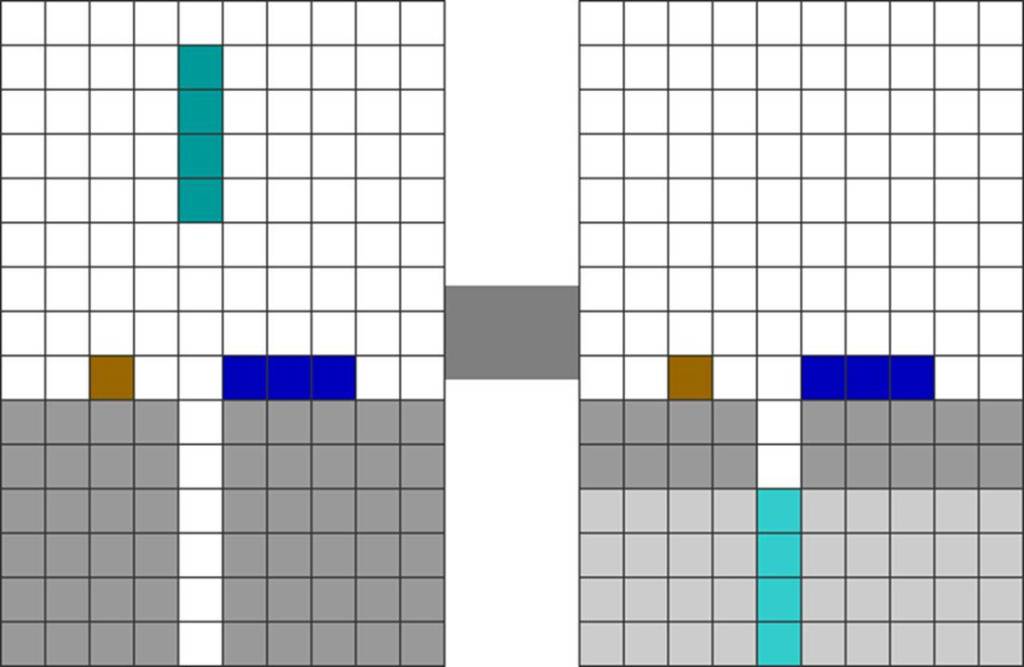
| Your opponent sends you 6 garbage lines. Your field rises by 6 lines. You prepare to insert an I piece into the central hole. | You insert the I piece into the central hole. An animation occurs, beginning to clear 4 lines. |
| 11 |
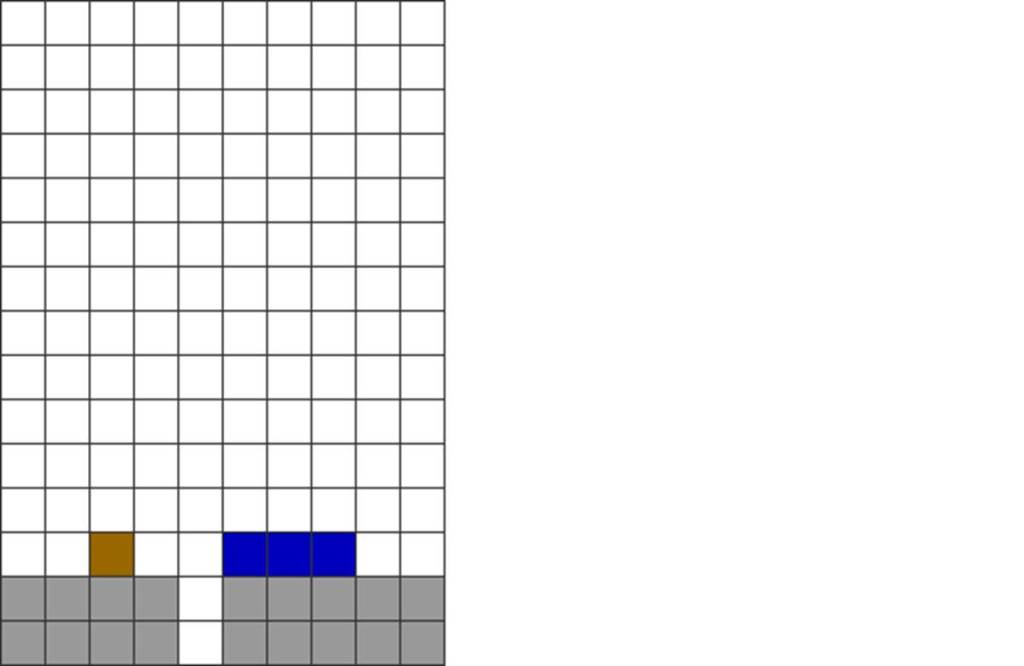
| After the 4 lines vanish, you safely lower your stack’s height. |
Did you notice how you safely reduced your field’s height?
Sometimes you want to keep your stack low because if it reaches the very top, you lose.
That’s All!
That is all! It was not so complicated, right?
If you play Chess or other similar board games, it is the same thing: two sweaty opponents battling each other for supremacy. It is also similar to sports games like soccer or basketball.
Remember the four concepts: (i) stacking, (ii) the Tetris, (iii) the T-spin, and (iv) digging down.
With just these four, you can understand many of this book’s Tetris examples without further technical knowledge.
Popular Tetris Game Modes
Tetris has both single-player and multiplayer modes:
- 40-line sprint is a mode where one tries to clear forty lines quickly.
- Ultra is a mode in which one tries to get the highest score by clearing lines in three minutes.
- Marathon is a mode where gravity starts slowly and speeds up later. The goal is to last as long as possible and score as high as possible.
- Versus modes involve a one-vs-one match, a free-for-all four-player match in Puyo Puyo Tetris or Tetris Effect, or a battle royale in Tetris 99, a one-vs-98 match. Players send garbage to each other’s fields to defeat each other.
My Tetris Guides
I have covered more Tetris strategies, theory, and methods in my two core Tetris websites, YouTube Tetris channel, and eight Tetris guidebooks:
How-to-Tetris Book Series Website: https://howtotetris.com/
My Casual Tetris Research Blog: https://galactoidtetris.wordpress.com/
My Tetris YouTube Channel:
https://www.youtube.com/@GalactoidTetris
If you have looked at the total volume and output of my Tetris guides, it is around 4,000 pages.
That is why I am uniquely qualified to write this Tetris spirituality and philosophy book.

